
How to Find Housing in New York City
A step-by-step guide to find the best case scenario apartment when you first move to the city.
2/1/202610 min read


The housing search in New York is high-pressure, fast, and expensive.
It's easy to find the wrong place. It's much harder to find (and secure) a decent place.
I spoke with dozens of New Yorkers and a real estate broker about how to navigate the process. If you know what you're looking for, and what the market offers, you will have realistic expectations and know when to jump on a unit (and when to hold off).
Want to watch thIs BLog as a video, which highlights the voices of these New Yorkers?
Check it out here. Be sure to comment and like the video, if you do! It has the same content as this blog.
Here’s what you’ll read in this blog:
Let's dive in!
How do you get started with the housing search?
Start by doing some soul searching, neighborhood visits, and cost estimates. Gather information about what kind of life you can sustain and would enjoy. Get out a blank document or journal page. Answer some of the questions in this blog. Think about the big and small pictures - what kind of lifestyle do you want? How much do you really know about NYC and what don't you know? How will you find it out? How much does your ideal lifestyle cost? What transit lines do you want to be near? Which areas can you afford? Are you okay with living in a basement unit? Do you want to be within a certain distance of a green space? Do you need a pet friendly unit? Are you okay with bringing your laundry to a laundromat or do you need to budget for a delivery service? How much do you have saved for the move, and how much more will you need? Does noise bother you? Are there certain institutions you need to be near?
Once you start to answer these exploratory questions, it'll help you narrow down to a handful or even one or two neighborhoods. Once you have narrowed down geographically, you can start to look online at listings to get a sense of the market and build your budget.
A visit to the city is critical to answering many of these questions. I understand that in some cases, visiting isn't feasible or you're willing to live anywhere for a year. Your options will be limited, since in-person visitors will have the edge over you at apartment showings. Just accept that you may get stuck with an apartment that's quite loud, tiny, ratty, or dark. But if you visit, take long walks around the neighborhood streets, central market areas, parks, and don't be afraid to ask someone if they enjoy the neighborhood. Then, plan to come back and stay at a short-term rental while you ferociously visit apartments.


How to Find Apartment listings online
95% of apartment listings are on one website: StreetEasy. Andre Mastrogiacomo, a licensed real estate broker in the city, explains why this is. Zillow owns StreetEasy, and it costs $7 dollars a day to keep a listing live. "So you're not going to have just random listings that aren't active, because you charge for every single day that they're up." said Andre. "Whereas some other sites, they're free. And so a lot of times you'll just see stuff that's been there for months and months. And you're just like, hey, I'd love to check this place out. And they're like, 'that place hasn't been available in like seven months.' And you're like, 'well, why is it there?' And they're like, 'I have no idea.'" Property listers would lose money keeping up a post for a rented apartment, so you know listings on StreetEasy are active.
Another major reason renters flock to StreetEasy is because most listings are legitimate. Scammers do not want to have to pay anything to scam people, so they use Facebook and Craigslist to try to switch and bait you. More on that in the next section.
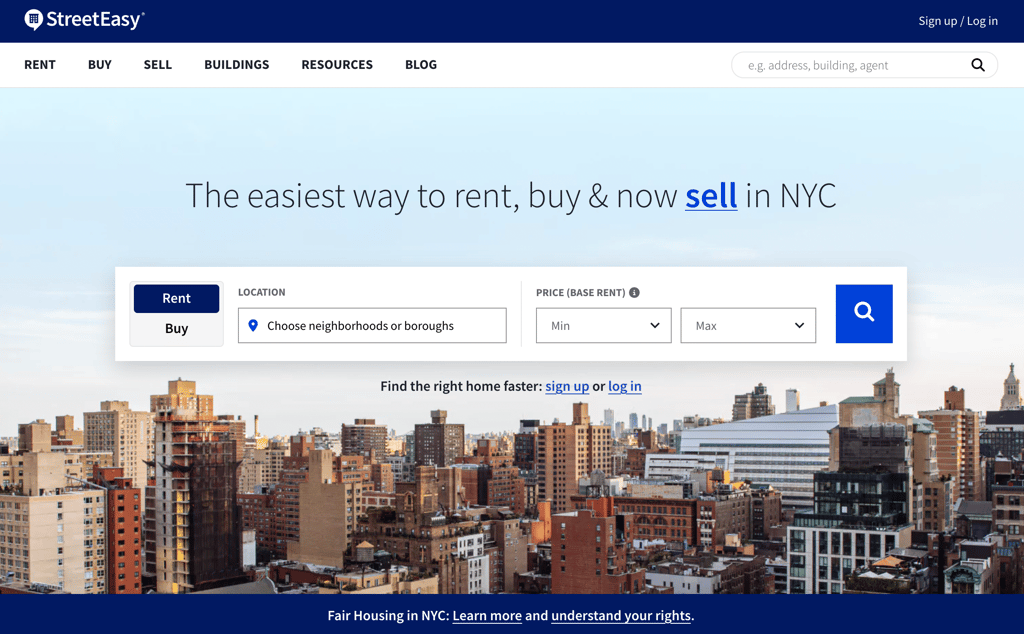
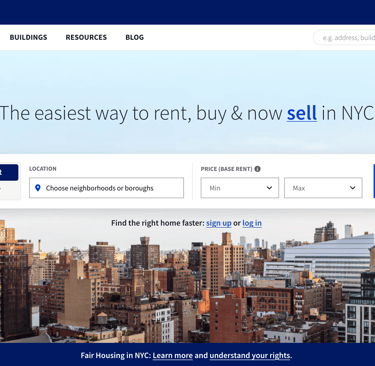
Start by looking at everything in a neighborhood. What are the high and low ends of what's on the market. I just searched for a 1-bed in Hell's Kitchen, and few are under $3,000. Get a sense for the quality of apartment at different costs. What's the difference between a $3,000 unit and $4,000 unit in terms of amenities, location, and building type? Keep in mind that virtually all listing photos are shot using a distorted perspective that makes units appear much larger than they actually are.
Look through Street Easy BEFORE you're ready to visit apartments. This is research that will help inform which neighborhoods you can really afford, and which amenities you can live without. Once you're ready to filter, play around with different restrictions:
Price
Pet preference (although some may indicate in the description that pets will be considered without selecting "Pets Allowed," so keep this in mind.)
Amenities (washer/dryer, dishwasher, laundry) - this and the pet filter drastically reduce your options.
How to Avoid Scams
NEVER, EVER give someone any form of payment before you've met with the agent, done your research, and signed a lease. A true broker will never request a code sent to your phone or bank information. A legitimate brokerage never gets the security deposit directly - it is written out to the property owner.
You need to vet each person you interact with, the companies they say they work for, and the entities listed on the lease for legitimacy. A quick google of each entity will quickly reveal if something is fishy or not.
Red flags to spot:
Based on your review of the market on Street Easy, the listing is unusually low priced.
There are unusual words or grammar used in the post.
They want you to share your phone number immediately so they can start texting you.
The provided broker or agency is not clearly associated with the rental market in New York City.
You can't find the agents name on the brokerage webpage.
They ask for a code they sent to your phone (they use this to set up a Google Phone Number associated with you, and pose as you to your bank or otherwise).
They are pressuring you in any way before you've seen the apartment.
The brokerage looks legit, but they want to you email or text a number that is not on the brokerage's official webpage.
Remember - real brokers don't need you that badly most of the time! They just need one good applicant to work out.
Here's an example:
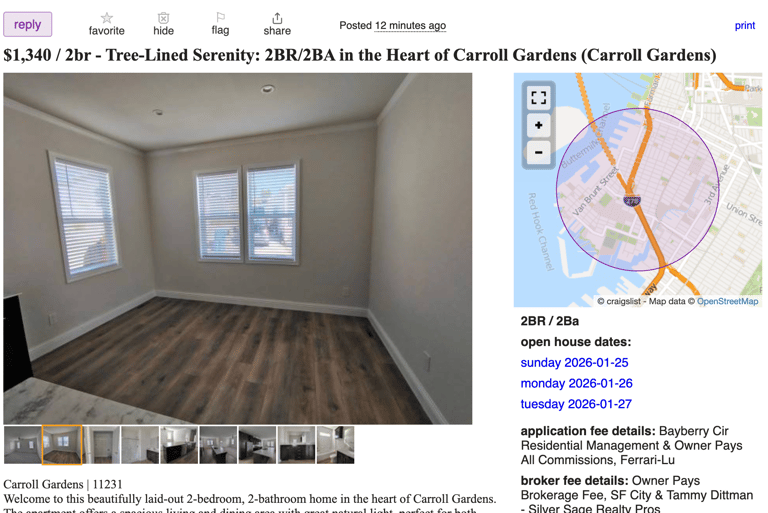
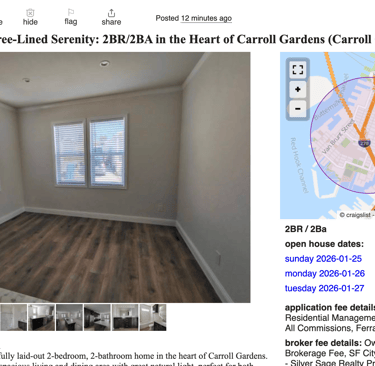
This post is on Craigslist, so I'm already taking a risk. The price is wildly low. Typical agents don't use words like "Tree-Lined Serenity." I googled the brokerage information and there's no clear evidence online that it's real. The post finishes with the instructions: "Kindly send your contact number for further discussion." Unlike with Street Easy listings, I can't see any address, so I can't search the location, either. This is clearly a scam.
While most all Street Easy postings are legitimate, it is possible for legitimate accounts to get hacked, which happened to Andre. Here he is explaining what happened, and how to avoid this unique scam:
"what they did is they hacked my account, [then] they lowered the price to get a million inquiries, and they put in the description their name and number - 'call me at this number.'"
To avoid any issues, always refer back to the contact information on the contact card associated with the listing -- not an alternate number provided in a listing description.
How to find Roomates
Very few people in NYC can afford to live alone, so it’s very common to have one or several roommates. There are a few different places to find them:
Your connections: reach out to everyone know, even if they don’t live in NYC. Chances are they know someone who does, and someone knows someone looking for a roommate.
If you must, check out websites that vet people:
Rainbow Roommates is tailored to the LGBTQ+ community.
Sometimes property brokerages also do the work too, like Nooklyn
This Streeteasy guide from 2022 has more great info on the nitty gritty. One piece of advice to highlight: Talk to people on the phone, ask them direct questions, make sure they have a history of paying rent on time, and read the fine print!
If it doesn't work out in the longer term, that's normal! You'll probably have changed your mind about which neighborhood you want to be in after a year in the city anyway.


Optimize your chances of getting selected
Yes - you're great! But so is everyone else applying to that apartment!
So how do you stand out?
Well, at a minimum, avoid making any behavioral or procedural mistakes. Andre, the real estate broker, and others talk about this at length in the episode. But I'll sum up their points here.
Be in person
Pay attention to detail
Be professional. Pretend this is a job interview.
Be prepared with all materials.
Be decisive
... But don't feel pressured.
Be on time, an early responder, and make a good impression. Being in-person ensures this.
Pay attention to detail. As Tomas describes in the episode - you want to find the discrepancies between the listing and reality, and there will be several.
This one goes out to folks who are newer to business transactions or job interviews. Being professional means that you dress well, be friendly, make eye contact, and ask questions but don't pester the broker. Your online presence is also fairly normal.
When you arrive you should have a folder on your computer set to go with all the application materials. If you decide you like the unit, leave and immediately apply. It should be easy enough for the broker to navigate through all these materials.
If they select you, be ready with your response. It happens fast. You should know the market by now and what your options are. You should know whether the condition is going to work for you or not. Don't sit in uncertainty. Decide.
And it's okay if it's a no - more will pop up.

How much Money do you need?
How much you need on the spot depends on:
The rent cost
Fees for applying and running a credit check
Your moving costs
How much cushion you want
For cash on hand, this is what you will need to secure a place (first month, security, and application fees in most cases).
If the rent is $3,000, you'll need at least $6,100.
If the rent is $6,000, you'll need at least $12,100.
If the rent is $10,000, you'll need at least $20,100.
*This doesn't include last-month or other fees that could arise. Ask the broker what upfront costs are, if the fees aren't clearly on the listing or application.
You and your roommates should collectively make 40 times the rent.
For $3,000, that's $120,000
For $6,000, that's $240,000
For $10,000 that's $400,000
If you don't your parent or family member will need to show that they make 80 times the rent and share bank statements, etc. demonstrating such.
Moving costs can vary, depending on your belongings. Call companies local to you or in NYC for some quotes. Remember that tipping is customary, thereafter.
Beyond this, it's always good to have further cushion in case something comes up on the spot - your moving truck gets a ticket, you need to replace a showerhead, or you just remembered to get rental insurance. Don't make this move more stressful than it needs to be! Make sure to always have 3 months worth of expenses saved up for worst-case scenarios.


How to read a lease and negotiate changes
First, check who’s listed on the document.
Verify that adds up with other sources. Is the property owner (whether an LLC or otherwise) real? Is the broker you've been working with listed as the broker? Is your information correct? Even if you can't find much on the owner if it is an LLC rather than a person, if the brokerage is legit (like Corcoran), then you know you're safe.
Take an hour to slowly read through the document. Do the terms align with what you've discussed with the broker? Develop a list of questions for them, for things you haven't asked about yet. Can you screw holes in the walls? What is the notice period for apartment entry? What is the pet policy? Be sure to be upfront if you have a pet. What does the lease say about pest control? There are plenty in NYC, so it's good to see if they cover that service.
Take your time. It's a dense document, but trust me you will get used to reading these in your lifetime. A lot of them have standard language in them. Don't be afraid to ask an experienced friend to read through it with you.
Once you have your list of questions, take them to the broker and see if any clarifications need to be added to the lease. When we moved into our current apartment, the lease said our dog was "not allowed in outdoor yard areas" because the landlord used a general lease template. We asked for an update, since we are the only folks who use that space. He had no issue clarifying the language.
You will thank yourself for sitting down and taking the time to read it. Trust me! It could save yourself heartache down the line.